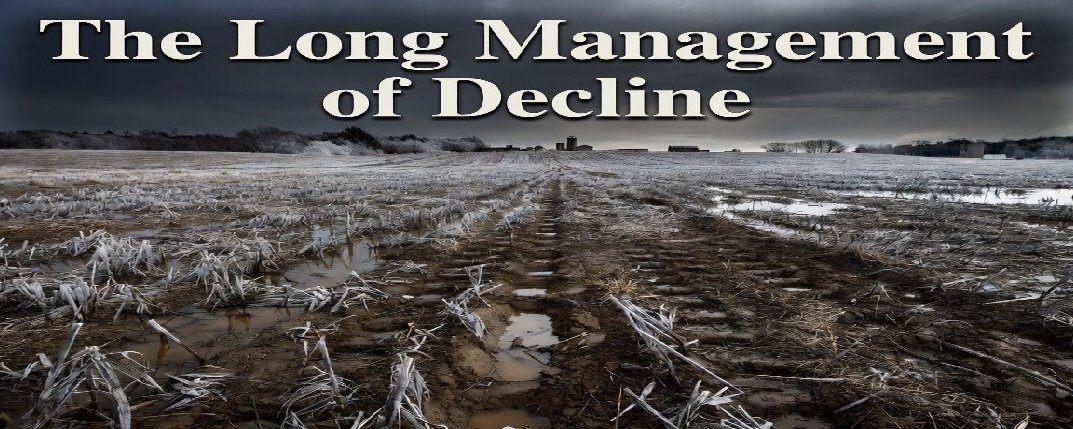
The sound of the low, deep rumble of the fertilizer train starts in March. It came a little later this year. Frost still grips the subsoil and the fields near North East Ohio lie gray and silent under a thin skin of last year’s stubble. The trains move before anything else stirs—a slow, steady thunder through the cold dark: tank cars of anhydrous, hoppers of urea and potash, thousands of tons pressing into the rails until the vibration settles into the foundations of houses and the bones of the men who will later spread it.
This year they were late. Shortages, shipping snarls, a supply chain stretched thin enough that even the feed mill could hear it hum. The ground waited, unmoved and indifferent, while the first sound of the season struggled down the line.
It is the first sound now. Not thaw, not birds, not the creeks running high with snowmelt. Before tillage, before the planter, before a single seed touches the soil, fertilizer has to arrive from somewhere far away—because the land no longer carries enough of what it once provided on its own.
The trains are only the beginning. After them come the trucks, the staging yards stacked with pallets and augers and rented bins. Then the equipment is rolled out of winter storage—planters the size of small buildings, sprayers with booms wide enough to fold a field into geometry. Every piece checked twice, because breakdown is not just delay anymore; it is risk measured in tens of thousands of dollars per hour, sometimes more when contracts and timing windows are tight.
And the fields themselves are still unreliable in March. Too soft in places, frozen in others. One wrong pass and a loaded machine can sink past the axles. It does not happen often, but it happens enough that operators remember. Nobody wants to recover a million-dollar planter buried to the frame in black soil that gives up no warning and very little forgiveness.
This is not a story about weather. It is a story about a system held in place by correction. Decades of intensive tillage, chemical dependence, and yield-driven economics have thinned the soil’s ability to recover faster than it can rebuild. The trains are the visible proof of what is no longer produced in place: synthetic inputs arriving like scheduled medicine for something that does not heal on its own.
There was a time when the thaw carried its own signal. The smell of something breaking down and returning—root, rot, renewal—rose from the fields without assistance. Now the season opens with the sharp edge of anhydrous ammonia, and planting feels less like beginning than intervention: adjusting, compensating, forcing conditions into alignment.
Farmers reach for what they have. Cover crops left to catch what winter would otherwise take. No-till systems that leave residue on the surface in an attempt to hold structure together. Drainage work where water lingers too long, pooling in low places that used to clear within hours. But even the best-managed fields carry signs of fatigue. After heavy rain, water sits longer than it once did, reflecting a sky that does not move.
The soil has changed in ways that are not immediately visible from a distance. Aggregates collapse more easily. Compaction layers form where machinery repeats its paths. Roots follow old channels instead of exploring new ones. The land still produces, but its margins are narrower, its recovery slower.
When the frost finally loosens, the season does not unfold—it compresses. Work begins at first light and continues until conditions fail. Planters roll while the surface is barely stable, heavy tires pressing moisture and structure into tighter layers. Every pass leaves something behind: a track that may not level out before harvest, a rut that becomes a drainage line, a line of stress that repeats the following year.
On leased or corporate ground, timing is not flexible. The calendar is a contract. Miss the window and yield drops; chase it too early and equipment suffers. The operator carries both outcomes at once. A field that should be greening becomes a calculation of whether it is worth entering yet, or whether another day of sun might make the difference between smooth passage and recovery work with chains and tow tractors.
And so the work proceeds under constraint. Machines move in long, uninterrupted lines when they can. When they cannot, they wait at field edges, idling, fuel burning while soil conditions are judged again and again. A delay is not just idle time—it is pressure building in another direction.
But the land keeps its own record. Water sits longer in the low places. Ruts deepen slightly each year, even when filled and smoothed. Fertilizer arrives, but not always on schedule, and not always in the same measure. The system does not break; it adjusts downward in increments too small to name in any single season.
From a distance, nothing appears wrong. Trains still run in March. Planters still move in April. Fields still resolve into straight lines and uniform emergence. The surface reads as continuity.
Up close, it is something else. Not collapse, but drift. A managed narrowing of possibility.
The land is still there. Still productive. Still expected to carry the same weight. But after each cycle, it holds a little less, and releases a little more slowly than it once did.