Carrying the Pattern — How the Home Base Travels and Rebuilds
That carrying isn’t just talk. It’s how things actually work. And once you see how it works, the question isn’t “where did the home base go?” It’s “how do we build it again?”
The home base still has to be the foundation—not the place. People move. Jobs take them far. Housing prices push them out. But the lessons learned at home travel with them. My family taught us to trust our gut — that it was acceptable to walk away from a deal or a situation that didn’t sit right before it hardened. This also meant not listening to the naysayers and following our instincts. That instinct, the willingness to step back or move forward without needing perfect certainty, became the most portable gift the floor gave us.
That portability depends on how the home base is built. Elders stay close and steady long enough that their judgment becomes part of how a child decides—not through lectures, but through living it out in front of them. Over time, people don’t just receive the home base; they become part of its strength, carrying forward the changes they once needed.
The danger is distance from the consequences. When decisions get too far from the people who have to live with them, small problems grow into bigger ones. We keep handing our troubles to HR departments, corporate programs, and government services, expecting them to catch us when it matters. They can’t. When it’s Friday night, your tire is flat, and you need someone who actually shows up, those systems aren’t there. Real support comes from people close enough to notice—and close enough to step in while the cost is still something we can handle together.
We were sold a story that real success meant leaving at eighteen, living alone, and measuring our worth by what we own. That story is falling apart. This shift starts with “Dollionaires”—ordinary people who treat what they have, no matter how small, as something to build with together. Not extra wealth, but shared stability: shared housing, shared risk, and shared memories. The home base also teaches you when to hear "no" from others and still go ahead anyway—not out of stubbornness, but because you have a feel for when something will work, even if you can’t prove it yet. That instinct isn’t arrogance. It’s the result of watching good judgment in action long enough to recognize when your own is ready.
Rebuilding this in practice means treating those who carry the long memory as essential, not as extra costs. It means building small, repeated groups whose job is to notice when things start to drift and correct it early. An empty house is a wasted resource; a full house is a reserve of strength.
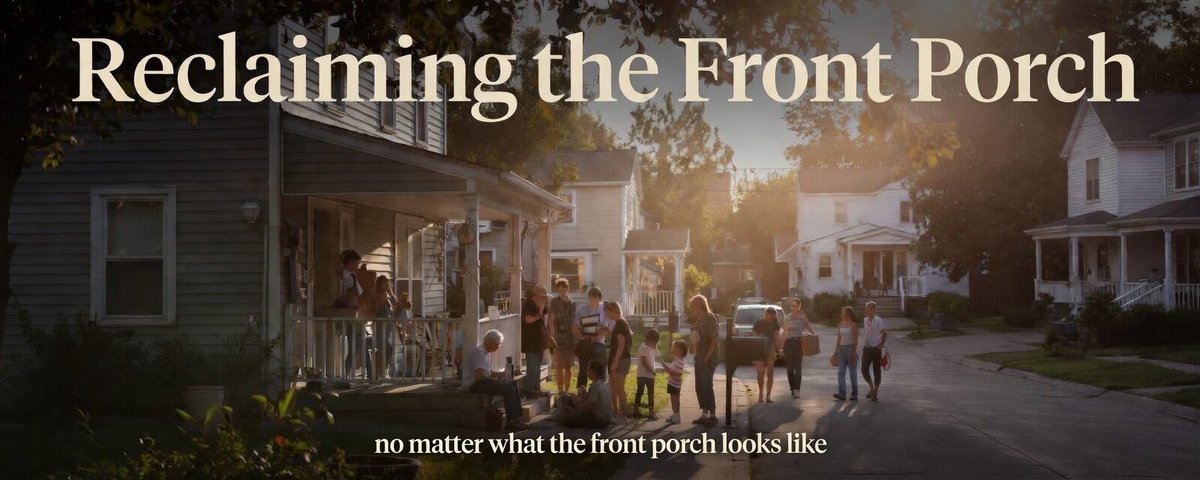
What that looks like in practice—and it doesn’t take much, doesn’t need permits or a meeting—starts with someone already nearby deciding to sit outside.
A retired nurse with a thermos on a park bench from five to seven, answering questions about home remedies she’s learned. A porch dinner where you cook extra and knock on a neighbor’s door to invite them over. A walking group that leaves from the mailboxes at 6:15—no leader, no RSVP, and bad weather cancels it. Even elders who sharpen knives or mend clothes can set up on a stoop for a couple of hours, and suddenly, people have a reason to stop and talk. Mahjong at dusk at a neighborhood park’s picnic table. A seed or tool “library” on someone’s front step—no checkout sheet, just return it when you’re done. And, of course, a thirty-minute stoop story swap: “I’ll tell one short memory, you tell one.” No theme, no microphone. Ends before anyone gets tired of it.
This rebuilding isn’t just for cul-de-sacs or front yards with room to spread out. Apartment dwellers and townhouse families carry the same portable home base, and they matter just as much—maybe more, because their proximity is already built in. In a high-rise, it might look like a Saturday-morning coffee rotation in the shared hallway or turning the laundry-room folding table into a check-in about what’s really going on with the people you live with. Simple gestures like borrowing or sharing a cup of rice help people realize they can provide simple help to each other and maybe receive it next time when they need it. The setting changes; the instinct doesn’t. Dollionaires in any kind of housing learn to notice the people within arm’s reach and turn small, repeated moments into the steady home base that distant systems can never provide.
These aren’t programs. They aren’t performances. They’re the home base showing up in a different form: low-stakes, high-proximity, and free. They happen in apartments with shared hallways, in cul-de-sacs where someone finally drags a chair to the curb, in townhouses where a carport becomes a gathering spot. The shape changes. The function doesn’t.
Even the smallest version works: an elder sitting outside on trash night, waving as people drag cans to the curb. Five minutes of faces. No agenda. Just the steady, quiet reminder that someone is still there—and that you’re not alone in trying to hold things together.
The government props up billionaires because if they fail, the whole structure fails. That scale has its place—it’s how we live as large as we do. But when Dollionaires lives get stress-tested, we look to them for help, but we can’t wait for them to fix our small stuff in a timely manner. They only give us bandages. We have to relearn this because this part is on us.
The home base didn’t disappear—it was taken apart, one “efficiency” at a time. But the pieces are still here. They’re in the families choosing to stay close, the friends choosing to share the load, and the stubborn insistence that we’re responsible for the people within reach.
I spent the first half of my life being told the old ways were a cage, and the second half watching a generation realize that we have nowhere to shelter during the storm. I’ve seen the gaps in the home base firsthand, and I’ve had to patch them for whoever is within reach—because someone has to. We aren’t waiting for a systemic rescue. We’re building the home base under our own feet, one repair at a time. The flour sacks are gone, but the lesson stayed: if you don’t build a place to stand, you’ll spend your whole life falling.