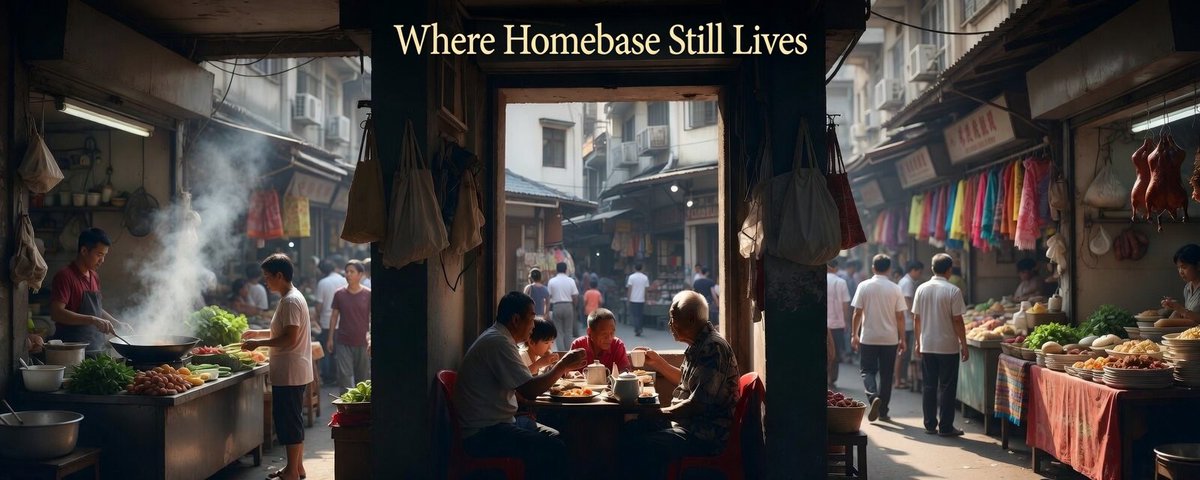
The living homebase still exists, though it is less visible inside modern life. It survives in communities fully embedded in contemporary society but still organized around proximity to elder presence. Not as authority in a formal sense, but as continuity — people who have already lived through earlier cycles remain close enough to recognize when something is beginning to repeat in a distorted form, and can interrupt it while correction is still cheap.
In households where this structure holds, elders are not background support but active stabilizers. They absorb irregular pressures like childcare gaps or financial strain, and they provide immediate, informal correction: a comment at the table about spending choices, a quiet refusal to let a familiar pattern in a child go unaddressed. The effect is not institutional. It is early, ordinary interruption before behavior becomes normalized.
The same pattern appears in tightly knit urban communities still functioning inside modern cities — Chinatown districts, Little Italy neighborhoods, Greek enclaves, and similar spaces. Older generations remain embedded in daily life not as symbolic figures, but as participants in family decisions, local commerce, and informal accountability, where memory of earlier outcomes still shapes present choices.
This is also why these figures persist in film and television. Grandparents are often written as comic relief or “wise, slightly grouchy” commentators, but the underlying recognition is structural: they represent continuous, low-level correction inside family systems. The writing flattens it into personality, but what it reflects is the role of older presence as a stabilizing reference point rather than a character trait.
This structure is visible in different forms across other living systems where it has been preserved. In Okinawa, moai groups distribute financial and social responsibility across lifelong networks where knowledge is continuously shared rather than stored. In many Indigenous governance systems, elder councils remain part of formal decision-making because prior outcomes are treated as active reference, not background history. In close-knit religious communities such as Orthodox enclaves, multigenerational households keep judgment anchored in lived consequence rather than abstract rule.
Across these cases, the shared condition is continuity: people who have already lived through earlier cycles remain inside the same decision environment where new ones are forming.
This is where cases like Reese’s become legible in a different way. When someone close to the original standard remains inside the system, they can still recognize when incremental change has crossed a boundary that was not formally marked, only remembered. In that moment, the correction is not abstract — it is the reintroduction of a prior reference point into a system that has drifted away from it. The signal only works when proximity and memory are still structurally present.
The shift, then, is not about losing knowledge, but losing early reference. Societies do not forget what worked; they lose the moment in the process where “this is already changing” is still visible and socially actionable.
The question that follows is not whether this can be restored in theory, but what conditions would need to exist for that kind of continuous, corrective presence to be re-embedded in everyday decision-making again.