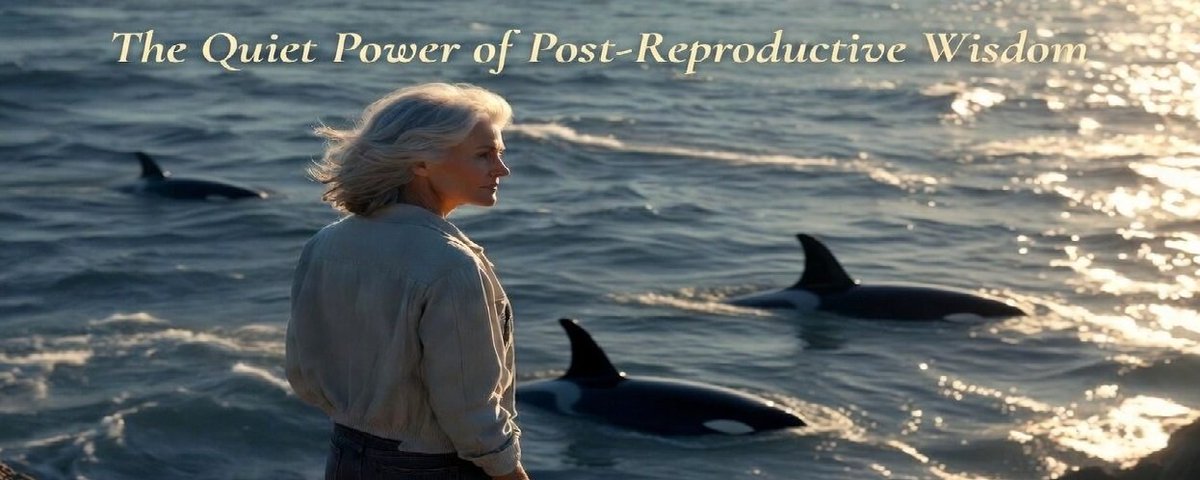
Start with a fact that never makes the brochures: only a handful of species live long past their reproductive years. Humans are one. Orcas are another. Most mammals reproduce until nearly the end. Even chimpanzees, our closest relatives, rarely live more than a few years past their last birth.
So when evolution sustains decades of post-reproductive life, the question is straightforward: why carry the cost of a body that produces no more offspring? Those costs are real—maintenance, vulnerability, slower repair.
The answer isn’t decline. It’s function.
If extra years persist, they tend to do so for a reason. Across species, they appear where they improve survival.
Take orcas. Females often stop calving in midlife and live decades more. On paper, that looks inefficient. In practice, pods led by older females are more likely to survive lean years. The advantage isn’t strength. It’s memory—where to go when familiar patterns fail. They aren’t producing new life. They’re preserving it.
Humans show a similar pattern. In many traditional societies, the presence of an engaged grandmother correlates with better child survival, steadier nutrition, and faster recovery for mothers. Human childrearing is unusually demanding—long, energy-intensive, difficult to manage alone. In that context, older women aren’t auxiliary. They’re structural.
Some of what they carry is visible—food, labor, care. Some of it is quieter: when to act, when to wait, how to recognize a shift early enough to matter. Not just knowledge. Timing.
Across generations, that contribution compounds. Those who lived beyond their fertile years and remained engaged improved the survival of those around them. Over time, that pattern holds.
We tend to frame menopause as loss—something ending. Biologically, it looks more like reallocation. What narrows in one dimension opens in another: time, attention, judgment directed outward.
Modern systems are poorly aligned with that shift. They reward speed, short-term output, early peaks—and sideline accumulated experience. Yet the traits that hold steady or even improve with age—pattern recognition, long memory, risk calibration, patience—are exactly the ones that matter most under uncertainty.
When those traits are sidelined, the loss isn’t sentimental. It’s practical: the absence of long-range judgment when it’s most needed.
Evolution isn’t sentimental either. Extending life beyond fertility carries real costs. For those costs to persist, the return had to be concrete.
It was.
So when a woman’s life is defined primarily by reproduction, biology offers a counterpoint. In some species, the individuals who hold things together under pressure aren’t the youngest or the most productive.
They’re the ones who have been paying attention the longest.
That’s not a consolation prize. It’s a role.