Soccer Saturdays
The summer had gone by the way water slipped through fingers: all at once and impossible to hold. One minute there had still been late mornings, melting popsicles, and Dani running through sprinklers in the yard; the next it was only a few weeks before school started again, the air already carrying the faintest edge of fall beneath the heat.
That was when Elena Patterson rode her bike up the Delgado driveway and skidded to a stop so hard the front tire left a pale crescent in the dust.
“Marisol!” she called.
Inside, the Delgado house was already awake in six different directions. Dani was on the floor sorting his “minerals” into piles no one else understood and correcting anyone who called them rocks. Tito was eating cereal out of a mixing bowl because all the regular bowls were in the sink. El Señor drifted through the kitchen with the weary dignity of an old supervisor checking whether anyone could be trusted with breakfast. Claudia was looking for her work shoes. Ernesto was at the counter buttering toast with one hand and reading the electric bill with the other. Rosa sat at the kitchen table with her green mug, watching all of it as if the noise itself were a weather system.
Marisol was drawing in her notebook, trying to get the curve of a horse’s neck right, when Elena called again.
“Marisol! Come outside!”
Marisol pushed back from the table. Through the screen door she could see Elena straddling her bike, breathless, her cheeks flushed, her helmet dangling crookedly from one handlebar.
“The girls’ soccer team is doing fall league,” Elena said the second Marisol stepped onto the porch. “Practices start this week. They need more players. Come with me? Please? I don’t want to do it alone.”
Marisol looked at the bike, then at Elena, then down at her own bare feet.
“I don’t play soccer,” she said.
“You can learn.”
“I don’t even know where my sneakers are.”
“You will find them if you look.”
“They’re not soccer sneakers.”
Elena made a face like this was the smallest problem in the known world. “Nobody cares. Please, Mari.”
Across the street, Mr. Jenkins was watering the strip of grass between the sidewalk and curb even though the sun had already dried the morning into a hot shimmer. A bus hissed at the corner. Somewhere down Cutter Street, someone’s radio played low through an open window.
Marisol liked quieter things. She liked sitting with Rosa in the kitchen while beans simmered and stories opened slowly. She liked reading in the basement where it smelled like old carpet and laundry soap. She liked drawing faces in the margins of her homework and listening to grown-ups talk when they forgot children were nearby.
Soccer sounded like running on purpose.
But Elena was her best friend, and there was something small and nervous under the brightness in her voice. So Marisol looked back through the screen door, where Rosa was turning her green mug slowly against the table as she watched the kitchen unfold around her, and then she said, “Fine. But if I’m terrible, you can’t pretend I’m not.”
Elena grinned. “Deal.”
The first practices were worse than Marisol expected.
The grass was scratchy and still damp in the evenings, even after the sun had slipped behind the houses. Gnats swarmed around everyone’s knees, and the air stayed thick and sticky. Even Coach Martin’s whistle seemed to struggle in the heat, while Marisol’s ponytail clung to the back of her neck and her shins ached in brand-new places she’d never noticed before.
The ball seemed to dislike her personally. When she tried to kick it straight, it veered sideways. When she tried to trap it, it bounced off her ankle and rolled away. Once, during a passing drill, she planted her foot right on top of it, and the ball shot out from under her so fast she fell backwards onto the grass. Elena burst out laughing, then quickly clapped both hands over her mouth, eyes wide with guilt and delight.
“It’s okay,” Elena said, trying very hard not to laugh again.
“It is not okay,” Marisol said from the grass.
At first she came home every evening sweaty and discouraged, freckled with dirt, her socks damp, her knees stained green, and her hair looking as if birds had tried to build something in it.
“I’m terrible,” she told Rosa one night, pushing rice around her plate. “I’m going to embarrass Elena.”
Rosa reached for the pitcher and refilled her water glass. The green mug sat beside her, steaming faintly even though the kitchen was warm.
“You’re learning, mija,” Rosa said. “That’s different from being terrible.”
“It feels the same.”
“Only in the beginning.”
Marisol was not sure she believed her, but she kept going.
Elena stayed late after practice to show her how to pass with the inside of her foot. Ernesto found an old half-flat ball that one of the kids had gotten as a present years earlier and pumped it up for her. Claudia even found shin guards at the discount store and held them up in the aisle like buried treasure. Even Tito helped, though he made it seem completely accidental.
“You’re kicking with your toe,” he said one evening from the porch rail, eating a popsicle that had stained his tongue blue. “That’s why it goes weird.”
“You don’t even play soccer.”
“I have eyes.”
“So does Mrs. Santos, apparently, and she doesn’t coach me.”
From three houses down, Mrs. Santos called without looking up from her flowerbeds, “I heard that, Marisol Delgado.”
Tito laughed so hard he nearly dropped his popsicle.
After dinner, Marisol started kicking the ball against the garage door. Thump. Roll. Thump. Roll. The sound carried down Cutter Street in the heavy evening air, mixing with sprinklers, screen doors sighing open and shut, the bell of Mr. Alvarez’s bicycle, Dani’s voice carefully explaining to El Señor why certain minerals were more important than others, and somebody’s television murmuring through an open window.
“Marisol!” Tito yelled out the window one night. “You’re going to wake the whole block!”
“It’s eight o’clock!”
“Some of us are delicate!”
“You are not delicate!”
Slowly, painfully, Marisol got better. Not good the way Elena was good—quick and light-footed, as if the ball were tied to her by an invisible string—but good enough that the ball no longer felt like a personal enemy. One Tuesday evening, during a passing drill under the fading light, the ball came toward her faster than usual. Instead of freezing, Marisol planted her left foot, swung her right the way Elena had shown her, and sent it clean across the grass. It landed right at Elena’s feet. Elena looked up with a surprised grin and shouted, “Yes, Mari! That’s it!” For the first time, Marisol felt the satisfaction of a pass that actually meant something. After that, she stopped praying for rain on practice days. She was still messy, still the slowest to recover, but she was no longer just surviving the game—she was beginning to play it.
Then school started.
The classrooms were hot even with the fans rattling in the windows. Dani went back to third grade with three sharpened pencils, one missing shoelace, and a backpack that rattled faintly because he refused to remove several “important minerals” from the front pocket. Marisol carried her sixth-grade backpack with both straps and tried to balance homework, practice, and the strange tiredness that came from learning new hallways.
The games began a couple of weeks later.
By mid-September, the team was getting ready to play North.
It was not a championship game. Nobody was keeping newspaper clippings or painting signs. But North was the team you always wanted to beat anyway. Half the girls knew each other from summer camps and church leagues and cousins. The parents always got louder during North games. Even Coach Martin seemed sharper all week at practice.
“Keep your shape, keep talking, keep your heads,” he kept saying while the girls ran drills under the late-afternoon sun.
By Saturday morning, the game had somehow grown bigger in everyone’s mind simply because it was North.
Marisol had been awake since five-thirty, sitting at the kitchen table in her blue jersey, her hair pulled into a ponytail so tight her eyebrows felt surprised. She checked her bag, then checked it again: water bottle, shin guards, cleats, lucky socks with a tiny hole near the toe.
“You check that bag one more time, it’s going to check you back,” Tito said, reaching past her for toast.
“Leave her alone,” Claudia said, but gently.
Rosa sat across from her with both hands around the green mug, turning it slowly against the table the way she did when she was thinking.
Claudia slid a plate of eggs and sweet plantains in front of Marisol. “Eat.”
“I’m not hungry.”
“That is not what I said.”
Marisol picked up her fork.
“I just don’t want to let Elena down,” she muttered. “Or the team.”
For a moment Rosa looked out the window at the small backyard, where the grass had gone patchy from heat and children and the old soccer ball El Señor occasionally tried to herd despite his age and stiff joints.
“Pressure comes whether you invite it or not,” Rosa said. “You still get to decide how you walk into it.”
Marisol made a face. “That sounds like one of your story things.”
Rosa smiled. “Maybe everything is one of my stories.”
The whole family piled into the old station wagon after breakfast while the front door sighed on its hinges behind them, giving up entirely on the idea of privacy. It was big and boxy, with wood-paneled sides and a back seat that faced the wrong direction. Ernesto drove. Claudia sat up front with a cooler full of orange slices and water bottles. Tito took the middle row with Marisol and complained that her soccer bag was touching him. Rosa sat in the very back with Dani, who believed the rear-facing seat was the finest invention in human history. El Señor occupied the narrow space beside Rosa with the solemn dignity of an aging security guard supervising transport operations.
“Everything’s going backward!” Dani shouted as they pulled away from the curb.
“You say that every time,” Tito said.
“And every time it’s true!”
They passed Mrs. Santos on the sidewalk, carrying a folding chair under one arm and a tote bag under the other.
“You coming?” Ernesto called through the open window.
“Of course I’m coming,” she said. “Who else will keep Daniel out of trouble?”
Dani pressed his face to the rear window. “I heard that!”
“I meant for you to hear that!”
At the fields, the morning had already turned warm. The grass smelled sharp and wet where it had been watered, and the dirt near the benches had baked into hard little ridges. Parents unfolded chairs along the sideline while neighbors from Cutter Street drifted toward each other automatically, carrying coolers, coffee thermoses, folding chairs, sunscreen, and opinions. Younger siblings chased each other between coolers. Someone opened a bag of sunflower seeds. Someone else had brought coffee in a thermos and poured it into tiny paper cups.
Marisol’s stomach twisted as she spotted Elena near the goal, bouncing on her toes.
“You came,” Elena said.
“I said I would.”
“I know, but still.”
They bumped shoulders, which somehow helped.
The game began in a rush of whistles and sneakers and girls calling for the ball. Marisol ran hard, not beautifully, but with a seriousness that settled over her like another uniform. She listened for Elena’s voice. She watched the ball, the other team’s feet, the gaps that opened and closed before she understood them.
“Mark up!” Coach Martin called.
“Go, Mari!” Claudia shouted.
“Kick it harder!” Dani yelled, whether or not Marisol was anywhere near the ball.
North scored first. Then Elena scored after a scramble in front of the goal, and the Delgado section clapped and shouted as if she were one of their own, because in the ways that mattered, she was.
Rosa sat beside Mrs. Santos with her cardigan folded in her lap in case the day cooled, though it showed no sign of doing so. El Señor rested across Rosa’s shoes beneath the folding chair, occasionally opening one cloudy eye whenever Dani got too close to the field.
Mrs. Alvarez arrived late from down the street, fanning herself with a paper plate.
“I brought empanadas,” she announced. “For after. Or before, if anyone is weak.”
“I am weak,” Tito said immediately.
“You can wait.”
On the field, Marisol chased a girl with a red headband down the sideline. The girl was faster, but Marisol stayed with her long enough to make her pass early. The ball went out.
“Nice pressure!” Coach Martin called.
Marisol bent over with her hands on her knees, breathing hard. Sweat ran down her temple. A blade of grass stuck to her shin. She looked toward the sideline and saw Rosa watching, calm and bright-eyed, as if she had known all along that Marisol could run this hard.
In the second half, Marisol took a tackle and went down on one knee. The whistle blew. Claudia half-stood from her chair, one hand already at her mouth.
“I’m okay!” Marisol called, though her knee stung fiercely.
Dani tried to step over the sideline with a mineral clutched in one fist. Mrs. Santos did not turn her head.
“Daniel Delgado, I have eyes in the back of my head. Get back here.”
Dani froze. “How did you know?”
“I always know.”
Marisol, jogging past during the restart, grinned despite herself. All her life she had wondered how Mrs. Santos knew when any child on Cutter Street was about to do something foolish. Now she was beginning to accept that some grown-ups simply had powers.
The score was tied 3–3 when the game began to feel loose and breathless. Nobody moved neatly anymore. Ponytails came undone. Socks slid down. Parents shouted advice that contradicted other advice. The sun climbed higher, and the field shimmered at the edges.
Elena got the ball near midfield and looked up.
“Marisol!” she called.
Marisol was open, though only for a second. Elena passed. The ball came fast over the grass, skipping once. Marisol trapped it clumsily but kept it close. A defender rushed toward her. For one terrible instant, Marisol forgot everything.
Then she heard Elena yell, “Middle!”
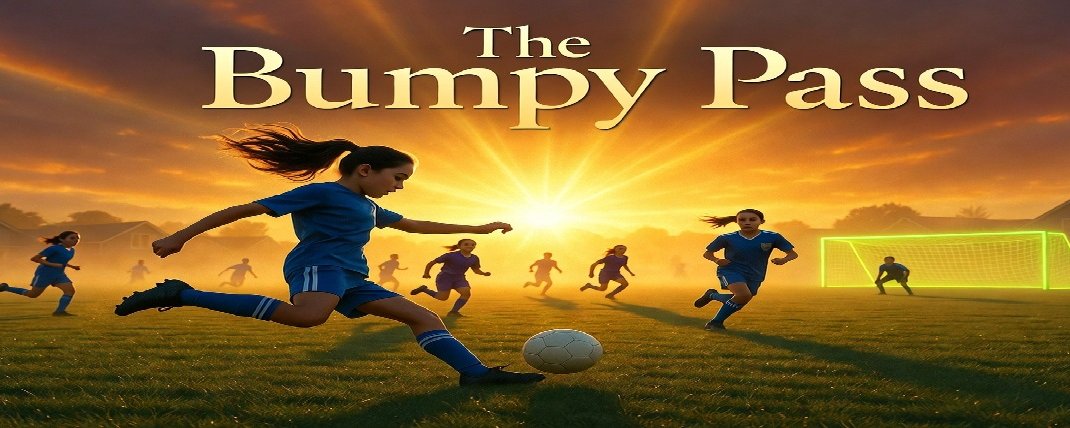
Marisol swung her foot the way Elena had taught her, inside of the foot, not the toe. The pass was not perfect. It bumped over a rough patch and made Carla from the other wing reach for it. But Carla got there. She pushed it ahead to Mina, and Mina kicked it low past the goalie.
For a second, there was only the ball in the net.
Then everyone shouted.
Elena ran straight at Marisol and hugged her so hard Marisol almost fell over again.
“You did it!” Elena said.
“I passed it!”
“I know!”
“That was on purpose!”
“I know!”
On the sideline, Tito whooped loudly enough to startle El Señor awake. Ernesto clapped until his hands stung. Claudia laughed with both hands pressed to her cheeks. Dani screamed, “That’s my sister!” and then, after a pause, “And my sister’s friend!”
They won 4–3.
Afterward, the girls lined up for handshakes, sweaty and red-faced under the late-morning sun.
“Good game.”
“Good game.”
“Good game.”
The words passed back and forth automatically at first, but not unkindly. Up close, the North girls looked just as tired as everyone else, shin guards slipping, ponytails coming loose, grass stuck to their socks.
When the handshake line broke apart, Coach Martin pulled the team in close while parents folded chairs and kids drifted toward the snacks.
“Good game,” he said. “You kept your heads, you talked to each other, and you started trusting the ball. That’s how we win. Now go get water before it’s all gone.”
The girls scattered immediately.
Near the folding chairs, Mrs. Alvarez opened her tray of empanadas, and the smell of warm pastry and seasoned meat drifted across the grass. Claudia passed out orange slices from the cooler while Mrs. Santos pulled out a bag of little rice cakes wrapped in plastic and handed them to Dani with strict instructions not to trade them for rocks. Ernesto gave out water bottles to the girls, and Rosa took an empanada, broke it in half, and shared part with Elena’s mother before she even had a chance to ask.
Mrs. Alvarez appeared again with a bright orange flyer.
“Great game, girls,” she said. “Tell your families we’re doing the Harvest Block Party next month. Cutter Street, Saturday at four. Everyone brings one dish.”
She handed the flyer to Marisol. “Your family always brings something good, so don’t let us down.”
Marisol carried it to Rosa, still breathing a little hard, her hair coming loose around her face.
Rosa read the flyer while Mrs. Santos leaned over her shoulder.
“I’ll bring a pancit,” Mrs. Santos said. “You bring that lasagna Claudia makes. Deal?”
Claudia laughed from behind the cooler. “I see how I’ve volunteered.”
“You make it better than anyone,” Mrs. Santos said.
“That is how they trap you,” Rosa said with a smile. “They compliment you and suddenly you’re cooking all Friday night.”
“The leaves will just be turning,” Mrs. Alvarez said. “It’ll be nice.”
Rosa tapped the orange paper with one finger. “Real nice.”
On the ride home, the station wagon felt lighter. Dani narrated everything through the back window as it moved away from him.
“There goes the gas station! There goes the dog with the bandana! There goes Mrs. Alvarez driving too slow!”
“Don’t say that,” Claudia said.
“But she is.”
Marisol leaned against the door, the paper certificate in her lap and the block party flyer tucked beside it. Her knee ached. Her socks smelled terrible. Grass clung to the edge of one shin guard. She was tired in a deep, glowing way, as if the whole morning were still running through her body.
That evening, after showers and dinner, after the house had settled into its usual not-quite quiet, Marisol sat on the porch steps with the orange flyer in her hands. The air was still sticky, late summer pretending it would last forever, but somewhere under it was the first thin thread of fall. Cut grass. Warm pavement. Beans cooling in the kitchen. Someone down the block laughing too loudly. A television murmuring through an open window.
Inside, Tito argued with the TV. Dani lined rocks along the windowsill in order from “most important” to “still important.” Claudia and Ernesto talked softly in the kitchen, their voices tired but kind. The house creaked and hummed around them, never silent, never empty.
Rosa came out and lowered herself carefully onto the step beside Marisol.
For a while they sat without talking.
“You did good today,” Rosa said at last.
Marisol looked down at the flyer. “The pass was kind of bumpy.”
Rosa made a dismissive sound. “Life is bumpy.”
“That also sounds like one of your story things.”
“Maybe you are finally listening.”
Marisol smiled.
Rosa rested one hand on her knee, light and warm. “You showed up for your friend. You kept trying when it was ugly. You let people cheer for you. Those are not small things.”
Across the street, the sky had turned peach-colored over the rooftops. Marisol thought of Rosa’s stories at the kitchen table, of cities with names that felt far away in the mouth, of people long gone who had carried food, bricks, songs, children, fear, hope. Those stories seemed enormous, stretching across deserts and oceans and centuries.
This day was only Cutter Street. A soccer field. A bumpy pass. Empanadas on paper plates. Mrs. Santos knowing everything and Elena’s arms around her after the goal.
But sitting beside Rosa in the warm evening, Marisol felt how ordinary things could widen too.
She leaned her head against Rosa’s shoulder, just for a moment.
Inside, the house went on making its familiar sounds. For once, Marisol did not mind any of them.